
News & Event
Caustic Soda Flakes 98% (NaOH 98% Min & China): Wastewater pH Neutralizer, Textile Scouring, Pulp Digestion & Detergent Manufacturing
Compiled by Tan Hung Phu Technical Team · Updated:
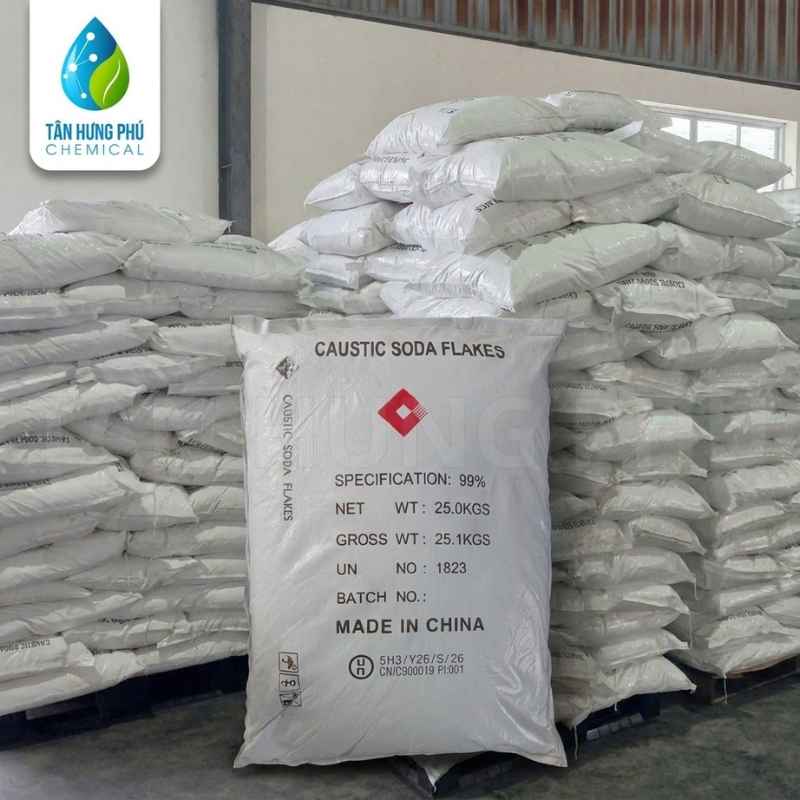
In centralized effluent treatment plant (ETP) operations, textile dyeing finishing, kraft pulp digesting, metal surface finishing, and detergent compounding, Caustic Soda Flakes 98% – 99% (chemical designation: Sodium Hydroxide – empirical formula NaOH) represents the foundational alkaline raw material with the highest industrial consumption worldwide. Manufactured via state-of-the-art Ion-Exchange Membrane chlor-alkali electrolysis conforming to Grade IS-IT-I (GB/T 209-2018 / GB 209-2006), solid caustic soda flakes packaged in 25 kg bags provide potent alkalinity alongside strictly suppressed sodium chloride and iron impurities. Mastering the chemical reaction mechanics of NaOH across wastewater processing units and industrial synthesis enables engineering teams to maintain operational safety while optimizing chemical consumption rates.
Executive Summary
- Chemical Identity: Sodium Hydroxide / Caustic Soda Flakes (NaOH, MW = 40.00 g/mol, CAS 1310-73-2, UN 1823), produced via Ion-Exchange Membrane technology (IS-IT-I).
- Quality Grades (GB/T 209 Standard): Categorized into three official grades: Superior Class (NaOH ≥ 99.0%, Fe2O3 ≤ 0.005%), First Class (NaOH ≥ 98.5%), and Qualified (NaOH ≥ 98.0% Min).
- Primary Industrial Applications: Acid neutralization, pH elevation, and heavy metal hydroxide precipitation (Cu2+, Ni2+, Cr3+, Fe3+, Zn2+) in wastewater; raw fabric scouring and mercerization in textiles; delignification in chemical pulping; alkaline metal degreasing.
- Safety Protocols: Severe exothermic heat of solution (ΔH = −44.51 kJ/mol); always introduce flakes slowly into cold water under mechanical agitation; never add water directly into dry caustic flakes.
Table of Contents:
- 1. Overview & Technical Specifications (IS-IT-I) of Caustic Soda Flakes (NaOH)
- 2. Wastewater Treatment: Acid Neutralization, pH Elevation & Heavy Metal Precipitation
- 3. Industrial Applications: Textile Dyeing, Kraft Pulping & Metal Surface Degreasing
- 4. Caustic Soda Flakes 25kg Portfolio Distributed by Tan Hung Phu Chemical
- 5. Chemical Safety Protocols: Mandatory PPE, Dissolution SOP & Alkaline Burn First Aid
- 6. Wholesale B2B Pricing and Procurement Guide for Caustic Soda Flakes in HCMC
- 7. Frequently Asked Questions (FAQ)
- 8. References & International Technical Standards
1. Overview & Technical Specifications (IS-IT-I) of Caustic Soda Flakes (NaOH)
Caustic Soda Flakes (technical nomenclature on COA: Ion-Exchange-membrane anhydrous caustic soda – Caustic soda flakes) represents the solid anhydrous form of Sodium Hydroxide (chemical formula NaOH, CAS No.: 1310-73-2). Synthesized by chlor-alkali brine electrolysis using advanced perfluorinated ion-exchange membranes (designated as grade IS-IT-I under national standard GB/T 209-2018 / GB 209-2006), the ultra-pure alkaline liquor is vacuum-concentrated and flaked into opaque white, free-flowing flakes that dissolve completely in water with 100% dissociation into Na+ and OH− ions.
The standard index values and chemical specifications governing Caustic Soda Flakes 98% – 99% according to international quality testing frameworks are outlined below:
| Inspection Index (GB/T 209 Standard – Grade IS-IT-I) |
Superior Class (High Purity – 99.0%) |
First Class (Standard Grade – 98.5%) |
Qualified (Commercial Grade – 98.0%) |
|---|---|---|---|
| Product Description | Ion-Exchange-membrane anhydrous caustic soda (Caustic soda flakes) | ||
| Sodium Hydroxide Purity (NaOH, %) | ≥ 99.0% | ≥ 98.5% | ≥ 98.0% |
| Sodium Chloride (NaCl, %) | ≤ 0.03% | ≤ 0.05% | ≤ 0.08% |
| Ferric Oxide (Fe2O3, %) | ≤ 0.005% (50 ppm) | ≤ 0.008% (80 ppm) | ≤ 0.01% (100 ppm) |
| Sodium Carbonate (Na2CO3, %) | ≤ 0.5% | ≤ 0.8% | ≤ 1.0% |
| Physicochemical Data & UN Classification | CAS: 1310-73-2 | UN 1823 (Class 8, PG II) | Melting Point: 318°C | Solubility: 1,090 g/L (20°C) | pH (1% soln): ~13.4 | ||
| Packaging & Shelf Life | 25 kg Net Bags (Heavy-duty woven PP bag with inner hermetic PE liner) | Shelf Life: 24 months | ||
2. Wastewater Treatment: Acid Neutralization, pH Elevation & Heavy Metal Precipitation
In industrial wastewater treatment systems, utilizing NaOH for wastewater treatment serves as the premier pH adjustment agent. Because of its instantaneous hydroxyl dissociation rate, it eliminates the massive volume of insoluble gypsum sludge (CaSO4) and pipe-encrusting scaling caused by hydrated lime Ca(OH)2.
2.1. Acid Neutralization and Optimal Alkalinity for PAC Coagulation & Biological Digestion
Industrial effluents from steel pickling lines, printed circuit board (PCB) etching, battery manufacturing, rubber, and food processing plants frequently exhibit aggressive acidity (pH 1.5 – 4.5). Dosing liquid caustic soda solutions at equalization basins satisfies three operational requirements:
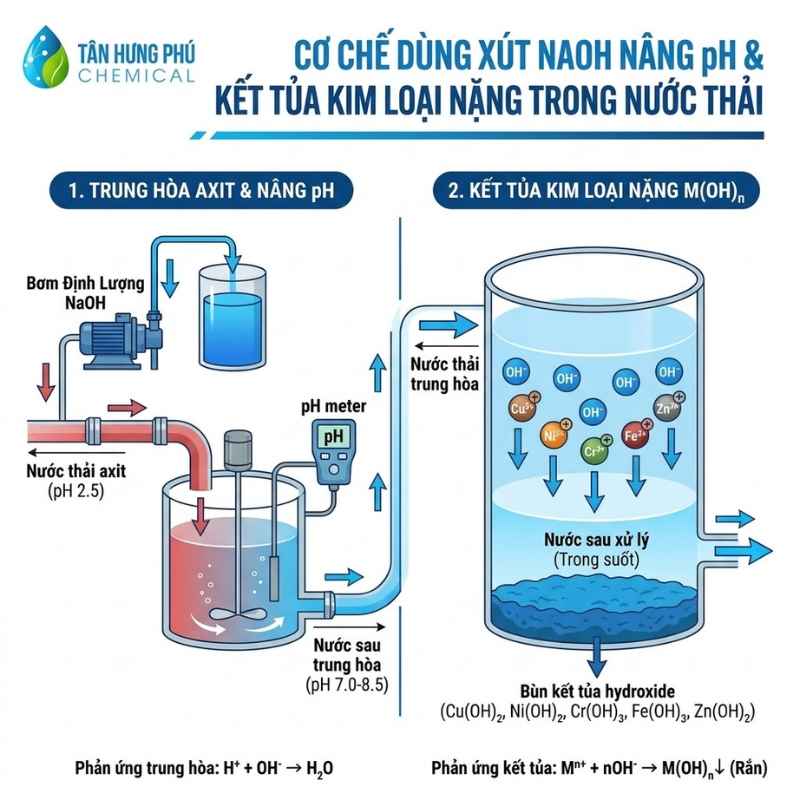
- Neutralizing Raw Effluent Prior to Final Discharge: Rapid acid-base neutralization (H+ + OH− → H2O) restores wastewater pH to statutory regulatory limits mandated by national environmental technical standards like QCVN 40:2025/BTNMT (pH 6.0 – 9.0 or 5.5 – 9.0 depending on discharge class and environmental licensing), protecting transfer pumps and pipelines from acid corrosion.
- Providing Buffer Alkalinity (pH 6.5 – 7.8) for PAC Coagulants: Polyaluminium Chloride (PAC 31%) consumes aqueous alkalinity to hydrolyze into insoluble aluminum hydroxide flocs [Al(OH)3] that bridge suspended colloidal particles. Conditioning with NaOH before dosing PAC ensures dense, shear-resistant flocs that settle rapidly.
- Stabilizing Biological Ecosystems (Aerotank / SBR / UASB): Maintains an optimal, stable pH of 6.8 – 8.0 in bioreactors, maximizing bacterial metabolic kinetics during BOD, COD removal, and aerobic nitrification cycles.
2.2. Heavy Metal Precipitation Mechanism (Separating Cu2+, Ni2+, Cr3+, Fe3+, Zn2+)
In electroplating and metallurgical effluent streams, heavy metal precipitation via NaOH converts soluble toxic cations (Mn+) into insoluble metal hydroxide flocs that settle into the clarifier underflow (Mn+ + nNaOH → M(OH)n↓ + nNa+). Because each cation reaches minimum theoretical solubility at a specific pH window, process technicians must calibrate setpoints on automatic pH controllers following jar testing:
| Heavy Metal Cation | Precipitated Hydroxide Morphology | Target pH Window & Operational Notes |
|---|---|---|
| Iron (Fe3+ / Fe2+) | Fe(OH)3↓ (Dense reddish-brown flocs) | pH = 5.0 – 8.5 (For Fe2+, preliminary aeration is required to oxidize it to Fe3+, or pH must exceed 9.5). |
| Chromium III (Cr3+) | Cr(OH)3↓ (Grey-green gelatinous flocs) | pH = 7.5 – 8.5 (Notice: Avoid exceeding pH 10.0 to prevent amphoteric redissolution into chromite anions CrO2−). |
| Copper (Cu2+) | Cu(OH)2↓ (Vibrant light-blue flocs) | pH = 8.5 – 9.5 (Achieves complete insolubilization; flocculates rapidly with anionic polymer). |
| Zinc (Zn2+) | Zn(OH)2↓ (White precipitate) | pH = 9.0 – 9.8 (Strictly avoid overdosing above pH 10.5 to prevent soluble zincate ZnO22− complex formation). |
| Nickel (Ni2+) | Ni(OH)2↓ (Pale green flocculent precipitate) | pH = 10.0 – 10.8 (Elevated alkaline pH is required to strip complexed nickel down to trace discharge limits). |
3. Industrial Applications: Textile Dyeing, Kraft Pulping & Metal Surface Degreasing
3.1. Textile Dyeing Finishing: Fabric Scouring and Cellulose Mercerization
In cotton, viscose, and blended fabric wet-processing lines, caustic soda flakes are essential across two preliminary treatment phases:
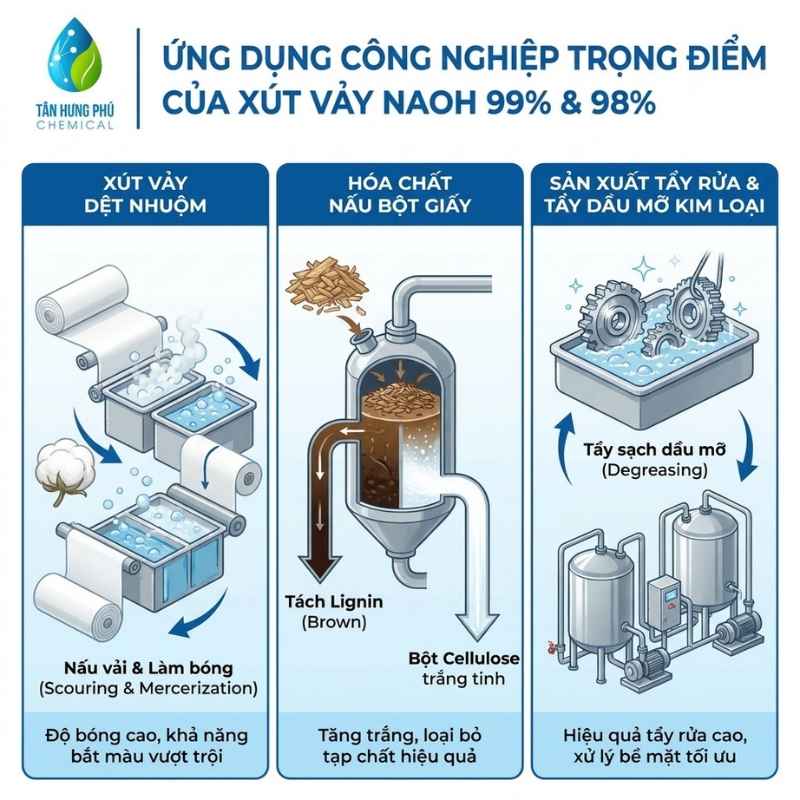
- Raw Greige Fabric Scouring: Raw cotton fibers contain natural waxes, cottonseed oil residues, and pectins that impart hydrophobicity. Boiling fabric in caustic scouring baths (concentration: 10 – 40 g/L at 95°C – 100°C) saponifies waxes and fats, removing seed hull fragments to ensure 100% uniform wetting and dye uptake prior to hydrogen peroxide (H2O2) bleaching.
- Cellulosic Fiber Mercerization: Immersing raw cotton webs under mechanical tension into concentrated Sodium Hydroxide solutions (18% – 25% w/w, approx. 220 – 300 g/L) causes cellulosic fibers to swell from flat, twisted ribbons into uniform round cylinders. This imparts a lustrous silk-like sheen, increases tensile strength by 20% – 30%, and boosts reactive dyestuff yield by 25% – 40%.
3.2. Chemical Pulp Digestion: Delignification to Extract Pure Cellulose
In packaging board and virgin paper mills, caustic soda acts as an irreplaceable chemical pulping agent in Kraft (sulfate) and Soda digestion circuits:
- Delignification Cleavage Mechanism: Within wood matrices, white cellulose fibers are bound by complex, hydrophobic lignin polymers. Cooking wood chips under pressure and elevated temperatures (150°C – 170°C) in NaOH white liquor cleaves ether linkages, converting insoluble lignin into soluble sodium lignates that dissolve into black liquor, recovering high-tenacity pure cellulose fibers.
- Recycled Fiber De-inking & Pulp Bleaching: NaOH swells recovered OCC/ONP paper fibers, saponifying printing ink binders to allow ink particle detachment and efficient flotation separation.
3.3. Industrial Detergent Compounding and Metal Surface Degreasing
- Surfactant Neutralization & Detergent Manufacturing: Neutralizes Linear Alkylbenzene Sulfonic Acid (LAS) to produce sodium LAS paste (LASNa) for laundry detergents and dishwashing liquids; saponifies animal tallow for bar soaps; produces sodium hypochlorite (Javen water) and alkaline CIP pipe cleaners for breweries and dairies.
- Alkaline Metal Degreasing: In mechanical engineering, cold rolling, electrostatic powder coating, and plating lines, immersing metal stampings in heated caustic degreasing baths (3% – 8% at 60°C – 80°C) saponifies and emulsifies anti-corrosion oils and stamping lubricants, producing a chemically clean metal surface before acid pickling.
4. Caustic Soda Flakes 25kg Portfolio Distributed by Tan Hung Phu Chemical
To satisfy diverse requirements from high-purity textile finishing and personal care manufacturing to high-capacity municipal wastewater treatment, Tan Hung Phu Chemical directly imports and inventories the following 25kg-packaged caustic soda flakes:
- High-Purity Caustic Soda Flakes 99% (Item Code: THP50): Caustic Soda Flakes NaOH 99% – Pure Sodium Hydroxide Chemical (25kg Bag – Code: THP50)
- Caustic Soda Flakes 98% Min (Item Code: THP12): Caustic Soda Flakes NaOH 98% Min – 25kg Bag (Code: THP12)
- China Caustic Soda Flakes 25kg (Item Code: THP9): Caustic Soda Flakes NaOH 98% – 99% China – 25kg Bag (Code: THP9)
Procurement specialists and plant managers can access technical specifications and download batch-certified Certificates of Analysis (COA) directly via the product links above. Additionally, explore our synchronized portfolio of water treatment and basic industrial chemicals (including Polyaluminium Chloride PAC 31% code THP21, Potassium Hydroxide Flakes KOH 90% code THP16, Calcium Hypochlorite 70%, and Citric Acid code THP18) in our commercial products catalog.
5. Chemical Safety Protocols: Mandatory PPE, Dissolution SOP & Alkaline Burn First Aid
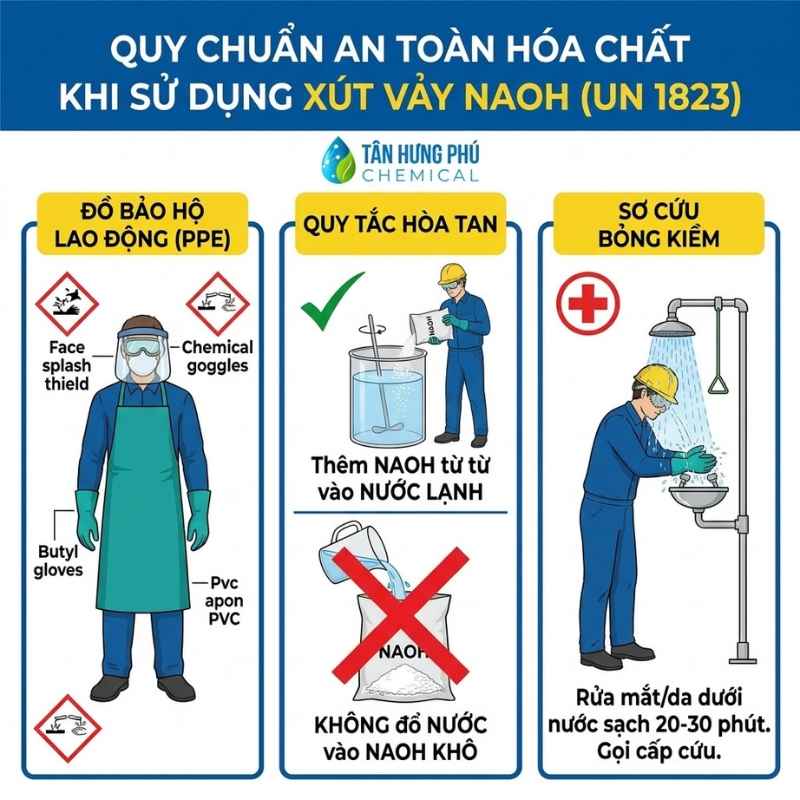
Dissolving Caustic Soda Flakes 98% – 99% in water is an intensely exothermic hydration reaction (ΔH°sol = −44.51 kJ/mol, releasing ~1,112 kJ of heat per kilogram of NaOH), which can rapidly elevate solution temperatures to 80°C – 95°C. Operators must NEVER pour water directly into dry flakes or partially emptied bags; localized boiling will flash water into steam, violently erupting concentrated caustic liquor onto personnel. The single authorized protocol: Fill the heat-resistant mixing tank with cold water, activate the mechanical agitator, and slowly disperse caustic flakes scoop by scoop into the vortex.
- Mandatory Personal Protective Equipment (PPE): Handlers opening bags or compounding solutions must wear panoramic chemical splash goggles with a full-face polycarbonate shield, extended chemical-resistant gauntlet gloves (heavy butyl, neoprene, or nitrile), an impervious PVC/rubber apron, steel-toe rubber work boots, and an alkali mist respirator.
- Vessel Materials & Storage Conditions: Use only heavy-gauge HDPE, PP, FRP composite, carbon steel, or 304/316L stainless steel tanks. Never use aluminum (Al), zinc (Zn), or galvanized steel, as NaOH vigorously corrodes these amphoteric metals, evolving flammable, explosive hydrogen gas (H2). Store 25 kg bags on dry pallets in ventilated areas; seal opened polyethylene liners airtight to prevent deliquescence and carbonate conversion from atmospheric CO2.
- First Aid Protocols for Caustic Chemical Exposure:
- Skin Exposure: Immediately strip off contaminated garments and footwear. Irrigate the affected dermis under a deluge shower or gentle stream of clean water continuously for at least 20 – 30 minutes until the slippery, soapy sensation is fully eliminated. Never pour vinegar or acid onto burned skin, as neutralization heat worsens tissue necrosis; seek immediate medical attention.
- Ocular Exposure: Force eyelids open and flush eyes immediately at an emergency eyewash fountain using clean tempered water or 0.9% sterile saline for a minimum of 30 minutes, and transport the victim to an ophthalmologist immediately.
6. Wholesale B2B Pricing and Procurement Guide for Caustic Soda Flakes in HCMC
When procurement teams at textile, paper, electroplating, and environmental facilities evaluate qualified caustic soda suppliers for recurring inventory replenishment, wholesale Caustic Soda Flakes 25kg pricing is determined by four practical factors:
- Assay Purity & Brand Origin: Tiered pricing corresponds to chemical purity levels (99% pure grade code THP50, standard 98% min code THP12, or China 25kg grade code THP9) aligned with targeted manufacturing requirements.
- Order Volume (MOQ & Logistics): Wholesale volume purchases per metric ton, palletized lots (40 bags = 1 metric ton), or full container loads (FCL 25 – 27 MT) at Tan Hung Phu Chemical benefit from direct importer discounts.
- Packaging Hermeticity & Crystal Quality: Deliveries are guaranteed in pristine 25 kg PP/PE bags, 100% dry, crisp, and free-flowing without caking or deliquescence.
- Compliance Documentation & Fleet Logistics: Accompanied by original Certificates of Analysis (COA), Safety Data Sheets (MSDS / SDS), and legal VAT invoicing. Rapid dispatch is coordinated across HCMC, Binh Duong, Dong Nai, Long An, Tay Ninh, Ba Ria – Vung Tau, and nationwide.
REQUEST WHOLESALE B2B QUOTATION FOR CAUSTIC SODA FLAKES 25KG BAGS (PER TON / CONTAINER)
To access the latest Caustic Soda Flakes 25kg pricing tailored to your plant specifications and consumption schedules, contact Tan Hung Phu Chemical’s B2B Commercial Sales Department directly:
Tan Hung Phu Chemical Co., Ltd. (THP Chemical)
• Technical Support & Wholesale Hotline: (+84) 913 711 647
• Commercial Inquiries (RFQ): tanhungphu@thpchemical.com
• Headquarters & Distribution Center: 878B Ta Quang Buu Street, Binh Dong Ward, Ho Chi Minh City & Regional Hubs (Prompt nationwide logistics via specialized commercial trucks and container haulage).
7. Frequently Asked Questions about Caustic Soda Flakes NaOH (FAQ)
What quality parameters on the COA define Grade IS-IT-I solid Caustic Soda Flakes?
Under standard GB/T 209-2018 / GB 209-2006 (Grade IS-IT-I – Ion-Exchange Membrane Anhydrous Caustic Soda), index parameters are classified into three quality tiers: Superior Class (NaOH ≥ 99.0%, NaCl ≤ 0.03%, Fe2O3 ≤ 0.005%, Na2CO3 ≤ 0.5%), First Class (NaOH ≥ 98.5%, NaCl ≤ 0.05%, Fe2O3 ≤ 0.008%, Na2CO3 ≤ 0.8%), and Qualified (NaOH ≥ 98.0%, NaCl ≤ 0.08%, Fe2O3 ≤ 0.01%, Na2CO3 ≤ 1.0%).
Why is Caustic Soda Flakes preferred over Hydrated Lime Ca(OH)₂ for wastewater pH adjustment?
When using hydrated lime Ca(OH)2 (especially in sulfate-bearing wastewater), calcium cations react with sulfate ions to generate massive volumes of calcium sulfate (CaSO4) gypsum sludge that scales pipelines, fouls dosing pumps, and increases dewatering expenses. In contrast, NaOH dissolves completely, neutralizes acidity instantaneously, and yields minimal residual sludge volume.
What pH ranges are required for heavy metal hydroxide precipitation using NaOH?
Different metals precipitate completely within distinct pH ranges: Ferric Iron (Fe3+) at pH 5.0 – 8.5; Chromium (Cr3+) at pH 7.5 – 8.5; Copper (Cu2+) at pH 8.5 – 9.5; Zinc (Zn2+) at pH 9.0 – 9.8; and Nickel (Ni2+) at pH 10.0 – 10.8. Crucially, do not exceed pH 10.0 – 10.5 for Cr3+ and Zn2+ to prevent amphoteric redissolution of the precipitates.
Why do textile scouring and mercerizing lines require low iron (Fe) caustic soda?
In textile wet-processing (scouring combined with H2O2 and mercerizing), excess iron (Fe) acts as a catalyst that decomposes hydrogen peroxide, causing pinholing/fiber degradation and yellowing white fabrics. Employing membrane-grade caustic soda with Fe2O3 ≤ 0.005% – 0.008% preserves fiber tensile strength and whiteness.
Why must water never be poured directly onto dry caustic soda flakes?
Due to the high dissolution enthalpy of Sodium Hydroxide (−44.51 kJ/mol), pouring a small amount of water directly into dry flakes produces intense localized boiling, violently erupting concentrated caustic liquor and causing severe chemical burns. The mandatory procedure is to charge the vessel with cold water first, engage agitation, and slowly add flakes into the water.
What is the wholesale price of Caustic Soda Flakes 25kg, and where can it be sourced in HCMC?
The price of Caustic Soda Flakes depends on the chosen specification (item codes THP50, THP12, or THP9) and order quantities (pallet, ton, or full container). For verified inventory in Ho Chi Minh City complete with manufacturer COAs and SDS documentation, contact Tan Hung Phu Chemical via Hotline/Zalo at (+84) 913 711 647.
8. References & International Technical Standards
The technical parameters on the COA, heavy metal hydroxide precipitation curves in wastewater treatment, and chemical safety standards for Caustic Soda Flakes presented in this document reference standard industry publications and regulatory authorities:
- Industrial Standard for Solid Caustic Soda: National Standard GB/T 209-2018 / GB 209-2006 (Industrial Sodium Hydroxide – Ion-Exchange-membrane anhydrous caustic soda, Product spec: IS-IT-I) and batch-specific import Certificates of Analysis.
- U.S. Environmental Protection Agency (U.S. EPA): EPA Wastewater Technology Fact Sheet – Hydroxide Precipitation of Heavy Metals Using Sodium Hydroxide – Solubility curves and optimal precipitation pH windows for Cu2+, Ni2+, Cr3+, Fe3+, and Zn2+.
- National Center for Biotechnology Information (NCBI – PubChem): PubChem Compound Summary for CID 14798: Sodium Hydroxide (NaOH – CAS 1310-73-2) – Physical constants, enthalpy of solution (−44.51 kJ/mol), and GHS classification (UN 1823).
- National Institute for Occupational Safety and Health (CDC / NIOSH) & Vietnam Standards: NIOSH Pocket Guide to Chemical Hazards – Sodium Hydroxide and National Technical Regulation on Industrial Wastewater QCVN 40:2025/BTNMT.
Summary: Serving as the vital alkaline agent for acid neutralization, heavy metal separation in wastewater facilities, textile fabric scouring, kraft pulp delignification, and industrial detergent compounding, Caustic Soda Flakes 98% – 99% (Sodium Hydroxide NaOH) remains indispensable across modern manufacturing. Sourcing verified caustic soda backed by complete batch COA and SDS documentation from Tan Hung Phu Chemical guarantees process stability, occupational safety, and long-term cost optimization.
Other News
View detail- What is MKP Fertilizer (Mono Potassium Phosphate 00-52-34)? Why is the 0% N – 52% P2O5 – 34% K2O Formula the Key to Off-Season Flowering?
- What is Citric Acid (E330 / INS 330)? Natural Origin, Refreshing Sour Taste and Metal Chelating Antioxidant Properties
- What is Chlorine 70% (Calcium Hypochlorite – Ca(ClO)₂)? Mechanism of Releasing Hypochlorous Acid (HOCl) for Water Disinfection
- What is Glacial Acetic Acid (GAA)? CH3COOH, Freezing Point at 16.6°C & Industrial Applications

