
Throughout years of supplying swimming pool water treatment chemicals and providing on-site technical support at numerous resorts, hotels, and large residential complexes, the Tan Hung Phu team has observed a recurring reality: pool water issues rarely happen due to a lack of chemicals. Most cases where water suddenly turns algae-green after heavy rain, becomes cloudy, or causes swimmer complaints about strong chlorine odors and eye irritation stem from dosing chemicals by guesswork before baseline parameters are properly balanced.
A standard swimming pool water treatment protocol requires synchronized coordination across functional groups: disinfection & chlorine stabilization (TCCA 90%, Stabilised Chlorine (SDIC 60%), Chlorine 70%, Purex Pool Stabiliser), pH balancing & alkalinity locking (Buffer, pH Increaser Powder Soda Ash Light, HCl balancing solution), algae control & phosphate management (Pool Algaecide, Phosphate Remover), as well as coagulation, heavy metal removal, and water polishing (PAC 31%, Pool Floc, Water Clarifier). This article compiles field-tested experience to help pool operators confidently select the right products, adjust the Langelier Saturation Index (LSI), and resolve three typical water problems at the most optimal cost.
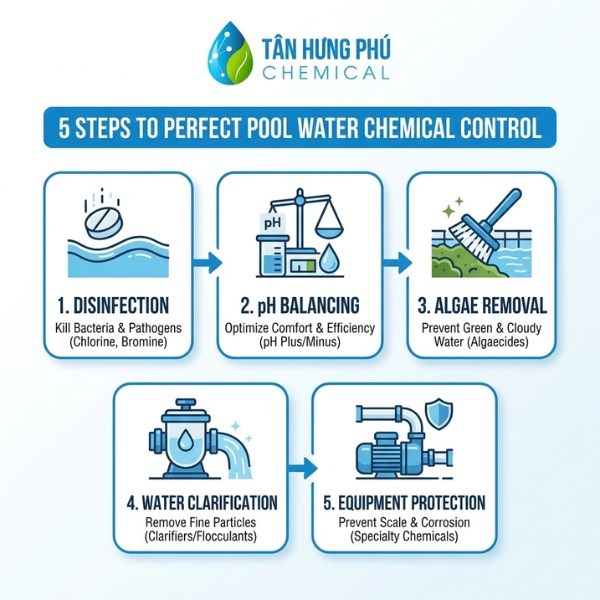
Quick Summary for Pool Operators
- Daily Sanitization vs. Shocking: Maintain daily free chlorine using TCCA 90% 200g tablets (slow-dissolving in a feeder/skimmer) or Stabilised Chlorine - SDIC 60% (instant-dissolving granules/powder with near-neutral pH, ideal for quick daily top-ups). For periodic shock treatment or algae remediation in pools with existing CYA, prioritize Calcium Hypochlorite (Chlorine 70%) to avoid excessive Cyanuric Acid (CYA) buildup.
- Mandatory Parameter Ranges: pH 7.2–7.6 · Total Alkalinity (TA) 80–120 ppm · Calcium Hardness 200–400 ppm · CYA 30–50 ppm · LSI within −0.3 to +0.3.
- Free Chlorine Scales with CYA: The higher the CYA, the higher the minimum required free chlorine. Rule of thumb: Minimum Free Chlorine ≈ 7.5% of CYA.
- Strong Chlorine Odor & Eye Irritation: This is caused by Combined Chlorine (Chloramines) formed when Free Chlorine is insufficient—not by excess chlorine. The solution is Breakpoint Chlorination.
- Algae-Green Water: Follow the exact technical sequence: Balance pH → Chlorine Shock → Algaecide (plus Phosphate removal if needed) → Flocculation → Vacuum directly to waste (in accordance with CPO® – PHTA technical guidelines).
1. Swimming Pool Water Treatment Chemical Groups & Selection Criteria
Each product group addresses a specific link in the water maintenance cycle. The reference table below categorizes the commercial pool care portfolio distributed by Tan Hung Phu:
| Functional Group | Tan Hung Phu Products | Application Purpose | Practical Notes |
|---|---|---|---|
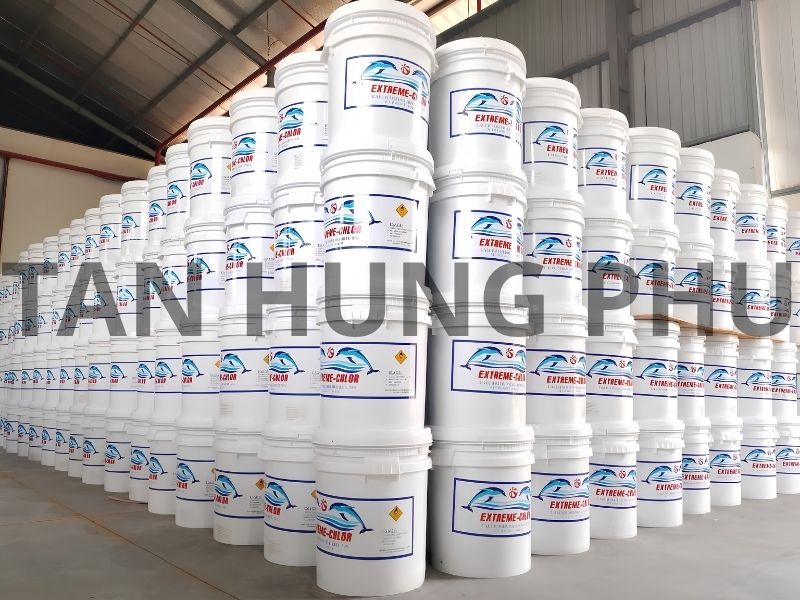
| Disinfection & Chlorine Stabilization | • TCCA 90% (200g Tablets / Granular / 20g Tablets) • Stabilised Chlorine (SDIC 60% Granular / Powder) • Chlorine 70% (40kg US Drum / 45kg Octagonal Drum) • Purex Pool Stabiliser (CYA Stabilizer) |
Maintain continuous free chlorine residual; shock-treat pathogens and shield chlorine molecules from UV degradation. | TCCA is mildly acidic and slow-dissolving. SDIC 60% dissolves 100% instantly with near-neutral pH, ideal for quick dosing and saltwater pools. Both TCCA and SDIC contain CYA. Chlorine 70% is alkaline, adds calcium, and adds zero CYA. |
| pH & Alkalinity Balancing | • Buffer (Alkalinity Increaser) • Specialized pH Increaser Powder (Soda Ash Light) • pH Reducer Solution (32% HCl) |
Keep pH within the safe, skin-and-eye-friendly range of 7.2–7.6 and lock Total Alkalinity at 80–120 ppm. | Always test and adjust Total Alkalinity to standard levels before fine-tuning pH to prevent pH bounce. For even dispersion and technical safety, pre-dissolve or dilute products in clean water before dosing (always add product slowly to water) and wear standard protective gloves and eyewear. |
| Algae Control & Nutrient Removal | • Pool Algaecide • Phosphate Remover |
Inhibit and eliminate green, black, and mustard algae; precipitate phosphates to starve algae of nutrients. | Dose algaecide after chlorine shocking. Prioritize copper-free formulas to prevent staining on light-colored pool tiles. |
| Flocculation & Water Polishing | • Pool Floc • PAC 31% (Poly Aluminium Chloride) • Water Clarifier |
Bind suspended particles and dead algae into heavy flocs for bottom vacuuming; restore crystal-clear water sparkle. | Pool Floc and PAC require turning off the pump for 8–12 hours of static settling before vacuuming to waste. Clarifier is dosed periodically while filtration is running. |
| Well Water Treatment & Filter Protection | • PAC 31% (Iron coagulation) • Buffer (Alkalinity stabilization & equipment protection) • Water Clarifier (Micro-metal particle trapping) |
Precipitate iron and manganese from borehole/well water; maintain balanced LSI to prevent calcium scaling on titanium salt chlorinator cells. | Essential for facilities using self-extracted groundwater or high-capacity heated pools. |
Water Disinfection: Combining TCCA 90%, Stabilised Chlorine (SDIC 60%), and Chlorine 70%
Sanitizers typically account for the largest share of a pool's maintenance budget. Field experience shows that each chlorine formulation has distinct strengths and should be combined flexibly based on water conditions:
- TCCA 90% (Trichloroisocyanuric Acid): Highly convenient thanks to slow-dissolving 200g tablets that last 5–7 days, ideal for maintaining steady baseline chlorine via an inline feeder or skimmer basket. TCCA contains built-in CYA stabilizer to protect chlorine from intense sunlight. Alongside 200g tablets, Tan Hung Phu supplies quick-sinking Granular TCCA (minimizing dust) and 20g mini-tablets for smaller water volumes.
Note when placing tablets in the Skimmer: only keep tablets in the basket while the pump is running, and remove them when the pump is turned off. Leaving tablets in stagnant skimmer water creates a localized high-concentration zone that can shorten the lifespan of pumps, filters, and fittings over time. Using a dedicated Feeder/Chlorinator is the most optimal approach. - Stabilised Chlorine – SDIC 60% (Sodium Dichloroisocyanurate): A stabilized organic chlorine in granule/powder form that dissolves 100% instantly without leaving calcium cloudiness (making it exceptionally compatible with saltwater pools). The greatest advantage of Stabilised Chlorine (SDIC 60%) is its near-neutral pH (~6.0–6.5), allowing effortless daily chlorine top-ups or post-peak-hour boosts with minimal impact on pool pH and Total Alkalinity.
- Calcium Hypochlorite (Chlorine 70%): Dissolves rapidly, delivers immediate oxidation power, and adds zero CYA. It is the ideal choice for algae shock treatments, breaking down Chloramines in pools that already have sufficient CYA, or treating naturally soft water (low calcium hardness).
| Technical Property | TCCA 90% (THP15 / THP13) | Stabilised Chlorine - SDIC 60% (THP35 / THP3) | Chlorine 70% (THP4 / THP5) |
|---|---|---|---|
| Available Chlorine Content | Approx. 90% | Approx. 56–60% | Approx. 65–70% |
| Solubility & Impact on pH | Slow-dissolving; mildly acidic, lowers pH and TA | 100% instant solubility; near-neutral pH, keeps water stable | Fast-dissolving; alkaline, raises pH |
| Cyanuric Acid (CYA) Accumulation | Gradual increase (~0.6 ppm CYA / 1 ppm Chlorine) | Gradual increase (~0.9 ppm CYA / 1 ppm Chlorine) | Zero CYA buildup |
| Impact on Calcium Hardness | No change | No change (zero scaling residue) | Slight increase (~0.7 ppm calcium / 1 ppm Chlorine) |
| Best Application | Automated multi-day baseline chlorine via Feeder | Quick daily chlorine dosing, resort/family & saltwater pools | CYA-free shock treatment, algae eradication, soft water balancing |
Balanced Combination Strategy: Use TCCA 90% tablets (or Stabilised Chlorine SDIC 60%) for steady daily baseline sanitation, combined with periodic shock dosing using Chlorine 70%. This approach allows the acidic and alkaline properties of the products to naturally offset each other while keeping CYA safely below 50 ppm over long operating periods.
Technical Safety Note: Never mix organic stabilized chlorines (TCCA, SDIC 60%) directly with inorganic Chlorine 70% in the same bucket or automatic feeder. These products must be dissolved and dosed separately to prevent localized heat reactions and equipment damage.
The Role of Alkalinity Buffering and Phosphate Control
Many technicians encounter constant pH fluctuations: adding pH reducer causes pH to drop too low, while adding pH increaser powder (Soda Ash Light) causes pH to spike. The root cause actually lies in Total Alkalinity (TA). Buffer (Sodium Bicarbonate) re-establishes the bicarbonate buffering system, locking Total Alkalinity at 80–120 ppm to anchor pH steadily within the optimal 7.2–7.6 range.
For outdoor pools surrounded by heavy foliage that experience recurring algae blooms despite proper chlorination, the underlying cause is often accumulated phosphates in the water. In such cases, alongside using Pool Algaecide to eliminate algae cells, operators can consider supplementing with Phosphate Remover to precipitate these nutrients—extending water clarity and reducing long-term maintenance effort.
2. Key Water Quality Parameters to Monitor Closely
Regarding legal regulations in Vietnam, the former Circular 02/2011/TT-BVHTTDL has been replaced by Circular 03/2018/TT-BVHTTDL and Decree 36/2019/ND-CP. Commercial pool operators must ensure feedwater complies with domestic water standard QCVN 01-1:2024/BYT and continuously maintain the following technical reference thresholds:
| Parameter | Standard Reference Range | Practical Significance |
|---|---|---|
| pH Level | 7.2 – 7.6 | Determines the percentage of active sanitizing chlorine and ensures gentle comfort for swimmers' skin and eyes. |
| Free Chlorine | 0.4 – 1.0 mg/l (VN Standard) / 1.0 – 3.0 ppm (International) | Concentration of active sanitizer immediately available to inactivate pathogens and algae. Pools with CYA (using TCCA, SDIC 60%) require higher Free Chlorine scaled to CYA (see Section 3). |
| Combined Chlorine (Chloramines) | ≤ 0.2 mg/l (ppm) | The direct culprit behind pungent chemical odors and eye discomfort when exceeding the threshold. |
| Turbidity | < 5 NTU (best practice: ≤ 0.5 – 1 NTU) | Ensures clear bottom visibility for lifeguard safety and optimizes chlorine disinfection efficiency. |
| Total Dissolved Solids (TDS) | < 1,500 ppm (above source water baseline) | Measures mineral concentration buildup over extended operating periods. |
| Total Coliform & E. coli | Coliform < 3 MPN/100ml; E. coli: 0 MPN/100ml | Microbiological safety requirement to completely protect swimmer health. |
Water Balance Parameters to Maintain Simultaneously
| Balance Parameter | Operating Range | Impact on Pool Structure & Equipment |
|---|---|---|
| Total Alkalinity (TA) | 80 – 120 ppm | Creates a stable buffer that prevents sharp pH swings after heavy rainfalls. |
| Calcium Hardness (CH) | 200 – 400 ppm | Protects tile grout and plaster, preventing water from etching pool surfaces. |
| Cyanuric Acid (CYA) | 30 – 50 ppm | Prevents UV sunlight from burning off free chlorine in outdoor pools. |
| Langelier Saturation Index (LSI) | −0.3 to +0.3 | Determines whether water is balanced, surface-etching, or scale-forming. |
3. Chemical Principles: pH vs. Active Chlorine, "Chlorine Lock", and LSI Calculation
How pH Affects Chlorine Disinfection Potency
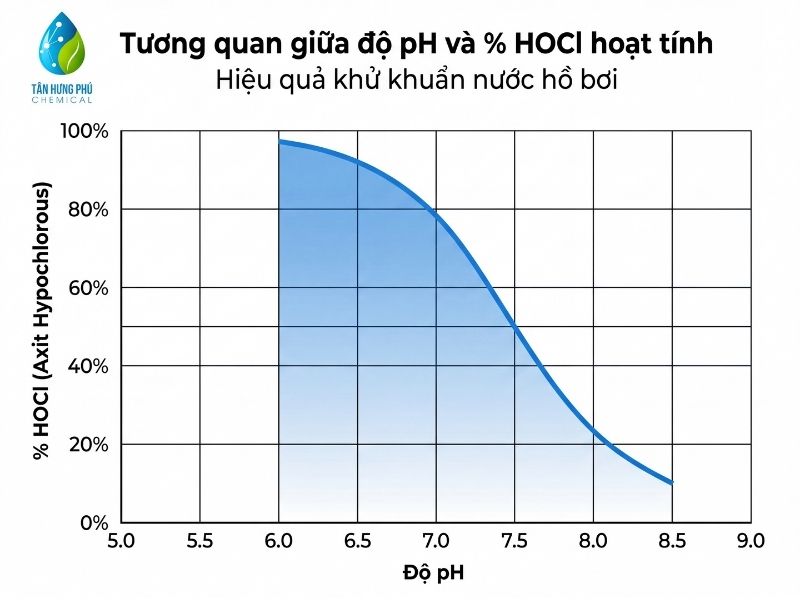
When chlorine dissolves in water, it dissociates into two equilibrium forms: Hypochlorous Acid (HOCl) and Hypochlorite Ion (OCl−). Electrically neutral HOCl molecules penetrate cell walls and destroy bacteria and algae 80–100 times faster than OCl− ions.
- At pH = 7.2: Approximately 66% of free chlorine exists as powerful sanitizing HOCl.
- At pH = 7.5: The HOCl ratio is roughly 49% – the optimal sweet spot balancing strong disinfection with swimmer eye and skin comfort.
- When pH rises to 8.0: Active HOCl drops sharply to only ~21%. At this point, even if test kits show sufficient chlorine residual, nearly 80% of the chlorine is sluggish, allowing green algae to bloom easily.
"Chlorine Lock" Caused by CYA Accumulation
Cyanuric Acid binds to chlorine to shield it from UV photolysis. However, CYA does not evaporate. When TCCA or SDIC is used continuously with minimal backwash water replacement, CYA levels can exceed 100 ppm, significantly lowering the water's Oxidation-Reduction Potential (ORP). Chlorine becomes "locked" and cannot release quickly enough to sanitize. To resolve this, operators must partially drain and dilute the pool with fresh water and switch to Chlorine 70% for shock dosing.
Relationship Between Free Chlorine and CYA
Because CYA holds onto a portion of chlorine in reserve, higher CYA levels require maintaining a higher Free Chlorine baseline. Many professional operators apply the following ratio:
| Current CYA Level | Minimum Free Chlorine (≈ 7.5% of CYA) | Algae Shock Chlorine Level (≈ 40% of CYA) |
|---|---|---|
| 30 ppm | ≈ 2.3 ppm | ≈ 12 ppm |
| 40 ppm | ≈ 3.0 ppm | ≈ 16 ppm |
| 50 ppm | ≈ 3.8 ppm | ≈ 20 ppm |
| 100 ppm | ≈ 7.5 ppm | ≈ 40 ppm (impractical; partial water dilution required) |
Langelier Saturation Index (LSI) Formula
The LSI indicates the calcium carbonate saturation balance of water, helping prevent material wear or scaling before damage occurs:
Where: TF is Temperature Factor; CF is Calcium Hardness Factor; AF is Corrected Alkalinity Factor (Corrected Alkalinity = TA − [CYA ÷ 3]); and TDSF is the Total Dissolved Solids constant (12.1 for standard freshwater pools, 12.2 for saltwater chlorinator pools).
| Water Temp | TF Factor | Calcium Hardness | CF Factor | Corrected Alkalinity | AF Factor |
|---|---|---|---|---|---|
| 24 °C | 0.6 | 150 ppm | 1.8 | 75 ppm | 1.9 |
| 29 °C (Typical VN) | 0.7 | 250 ppm | 2.0 | 100 ppm | 2.0 |
| 34 °C | 0.8 | 300 ppm | 2.1 | 125 ppm | 2.1 |
LSI Calculation Example at 29 °C: Measured pH = 7.4 · Calcium Hardness = 250 ppm · TA = 110 ppm · CYA = 30 ppm · Freshwater (TDSF = 12.1).
Corrected Alkalinity = 110 − (30 ÷ 3) = 100 ppm. From the table: TF = 0.7; CF = 2.0; AF = 2.0.
LSI = 7.4 + 0.7 + 2.0 + 2.0 − 12.1 = 0.0 – Perfectly balanced water; no adjustment needed.
Result Evaluation: Water is ideally balanced when LSI falls between −0.3 and +0.3. If LSI < −0.3, water tends to etch pool walls, tile grout, and metal fittings. If LSI > +0.3, water is over-saturated and prone to depositing calcium scale, dulling tiles and fouling salt chlorinator cells.
4. Technical Protocols for Resolving Three Common Issues in a 300 m³ Commercial Pool
Below are standardized recovery procedures that restore water quality rapidly at a fraction of the cost of draining and refilling the pool, modeled on a standard 300 m³ commercial pool (reference dimensions: 25 m × 8 m × 1.5 m):
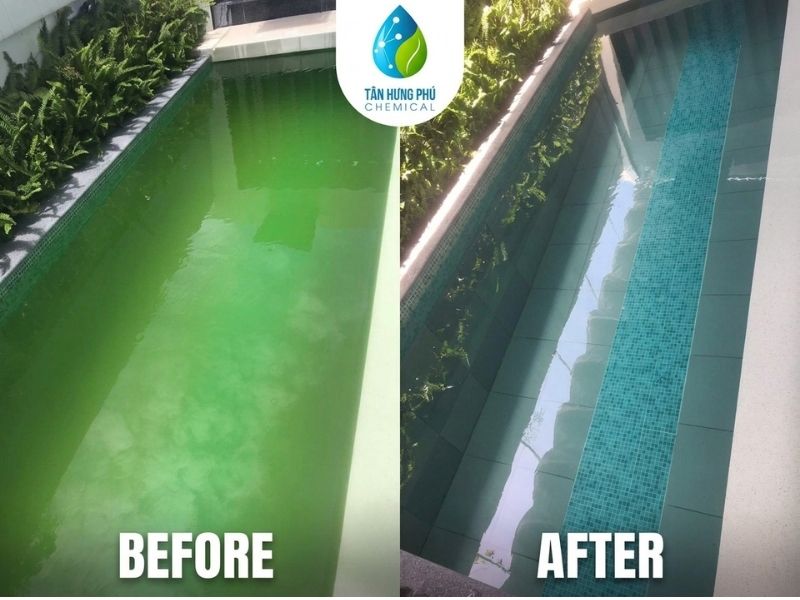
Issue 1: Pool Water Turns Algae-Green After Heavy Rainstorms
- Brush Surfaces & Balance pH (Step 1): Thoroughly brush tile grout lines to break up protective algae biofilms. Test the water: if Total Alkalinity (TA) dropped to 60 ppm, dose 9 kg of Buffer to bring TA back to 80 ppm, then adjust pH to 7.2.
- High-Level Chlorine Shock (Step 2 - Perform in late afternoon): Raise Free Chlorine to 10 ppm to eradicate algae cells (if CYA exceeds 30 ppm, scale chlorine dosage according to Section 3). Pre-dissolve and broadcast 4.3 kg of Chlorine 70% evenly around the pool with the circulation pump running continuously.
- Dose Algaecide & Prevent Recurrence (Step 3): Pour 3–4.5 liters of Pool Algaecide evenly around the pool perimeter to eliminate remaining algae roots. Once the water turns milky-cloudy (indicating dead algae), you can proceed directly to Step 4 to optimize treatment costs. (Advanced Optional Step: For outdoor pools with heavy leaf fall or frequent recurring algae blooms, operators may supplement with Phosphate Remover to strip reserve nutrients—ensuring long-term water stability while remaining far more economical than draining and replacing the entire pool volume).
- Overnight Static Flocculation (Step 4): Set the multiport valve to Recirculate (bypassing the sand bed), pre-dissolve 1.5–3.0 kg of Pool Floc or PAC 31%. Run the pump for 30 minutes to disperse evenly, then shut off the pump completely for 8–10 hours.
- Vacuum Sediment to Waste (Step 5): The next morning, switch the multiport valve to Waste and vacuum the pool floor slowly to discharge settled sediment directly to the drain. Top up lost water and dose Water Clarifier to restore a sparkling, crystal-clear finish.
Issue 2: Pungent Chlorine Odor and Eye Irritation
A sharp chemical smell occurs when Combined Chlorine (Chloramines) exceeds 0.2 ppm due to insufficient Free Chlorine to completely oxidize organic nitrogen compounds from swimmer sweat.
Breakpoint Chlorination for a 300 m³ Pool: If Combined Chlorine measures at 0.8 ppm, you must add Free Chlorine equal to 10 times that value—equivalent to 8.0 ppm of active chlorine. The pure chlorine mass required is 2.4 kg (300 m³ × 8 g/m³). Using Chlorine 70% to avoid raising CYA, the actual product weight needed is 3.43 kg. Perform shock treatment at night with continuous filtration to completely destroy Chloramines, restoring odor-free, gentle water.
Issue 3: Water Turns Brownish-Yellow or Dark Green When Using Well Water
Groundwater from boreholes often contains dissolved heavy metal ions such as Iron (Fe2+), Manganese (Mn2+), and Copper. When oxidizing chlorine is added, these ions precipitate into suspended metal oxides, tinting the water tea-yellow or dark brown and staining tiles.
Intervention for a 300 m³ Pool: First, check and stabilize alkalinity using Buffer and slightly raise pH to 7.5–7.6 (using Soda Ash Light pH increaser powder) to accelerate complete metal precipitation. Next, set the filter valve to Recirculate, pre-dissolve 2.0–3.0 kg of PAC 31% (or Pool Floc), distribute evenly across the pool, circulate for 30 minutes, then shut off the pump to settle overnight (8–12 hours). The next morning, switch the valve to Waste and vacuum the settled metallic sludge from the bottom. Finally, resume normal filtration and dose 500–750 ml of Water Clarifier to trap remaining micro-particles in the sand filter and restore crystal clarity.
Do Not Overlook Mechanical Factors: Circulation & Filtration
Water treatment products only perform at their best when water is properly circulated and filtered. Recurring issues despite accurate chemical dosing often stem from mechanical bottlenecks:
- Turnover Rate: Main commercial pools are typically designed to turn over their entire water volume every 4–6 hours; wading pools and spas require much faster turnover. Running pumps for insufficient hours creates "dead spots" where algae begins to grow.
- Backwashing: Perform a backwash when the filter pressure gauge rises by 0.5 bar (7–8 psi) above the clean starting pressure, or on a fixed schedule. Filter sand that is clumped or channeled after 5–7 years should be replaced.
- Bather Load: Peak swimming hours cause Combined Chlorine to rise rapidly. Test Total and Free Chlorine immediately after high-traffic periods.
- Swimmer Hygiene: Enforcing pre-swim showers significantly reduces sweat, sunscreen, and hair oils—the primary precursors to Chloramines and Phosphates.
5. Standard Dosing Reference Table (per 100 m³ of Water) & Testing Frequency
| Adjustment Goal | Product Used | Target Change | Dosage / 100 m³ Water |
|---|---|---|---|
| Maintain Chlorine Residual (Slow-dissolving) | TCCA 90% (200g Tablets / Granular) | Increase Free Chlorine by +1.0 ppm | 112 grams |
| Quick Stabilized Chlorine Boost (Instant-dissolving) | Stabilised Chlorine (SDIC 60%) | Increase Free Chlorine by +1.0 ppm (pH-neutral) | 167 grams |
| CYA-Free Chlorine Shock | Chlorine 70% | Increase Free Chlorine by +1.0 ppm | 145 grams |
| Raise Total Alkalinity (TA) | Buffer (Sodium Bicarbonate) | Increase TA by +10 ppm | 1.5 kg – 1.7 kg |
| Raise pH Level | Specialized pH Increaser Powder (Soda Ash Light) | Increase pH by +0.2 units | 1.0 kg – 1.5 kg (pre-dissolve thoroughly before broadcasting) |
| Lower pH & Total Alkalinity (TA) | pH Reducer Solution (32% HCl) | Decrease TA by 10 ppm (simultaneously lowers pH) | ≈ 2.0 liters (dilute, dose in increments, retest after 1 hour) |
| Add CYA Stabilizer | Purex Pool Stabiliser | Increase CYA by +10 ppm | 1.0 kg |
| Bottom Flocculation for Cloudy Water | Pool Floc or PAC 31% | Static bottom settling | 0.5 kg – 1.0 kg |
| Continuous Water Polishing | Water Clarifier | Coagulate micro-particles via sand filter | 150 ml – 250 ml |
* Dosages are for reference under standard conditions. Always dose half the estimated amount first, circulate for 1–2 hours, and retest before adding more. Only use Purex Pool Stabiliser for outdoor pools not yet using TCCA/SDIC or when CYA is below 30 ppm.
Routine Water Testing Schedule for Operators
| Parameter to Test | Recommended Frequency |
|---|---|
| Free Chlorine, pH | 2–3 times/day: early morning before opening, midday, and end of day. |
| Total Chlorine (to calculate Combined Chlorine) | Daily, or immediately whenever a chlorine odor is noticed around the pool. |
| Total Alkalinity (TA), CYA | Once a week; test additionally after heavy rainstorms. |
| Calcium Hardness (CH), TDS, Phosphates, LSI | Once a month, or after large fresh water top-ups. |
| Microbiological Indicators (Coliform, E. coli) | Periodically according to local health authority inspection requirements. |
6. Storage & Handling Guidelines for Pool Care Products
Sanitizing and pH-balancing products are formulated in concentrated form to treat large volumes of water efficiently. Once properly dissolved and balanced in the pool, the water is completely safe and gentle for swimmers. During storage and initial preparation, operators should follow these standard technical practices:
- Storage: Keep in a cool, dry, well-ventilated area away from direct sunlight; reseal packaging tightly after each use. Store TCCA, Stabilised Chlorine (SDIC 60%), Chlorine 70%, and pH-adjusting liquids on separate shelves/zones away from oils or flammable materials.
- Independent Handling: Never mix different types of chlorine together, and never mix chlorine with pH-reducing solutions in the same container. Use a dedicated, clean, dry measuring cup for each product.
- Standard Dilution Sequence: Always add chemicals slowly into water when pre-dissolving; never pour water directly onto concentrated products. Dose different product groups at least a few circulation hours apart, or follow label instructions.
- Personal Protective Equipment (PPE): Wear chemical-resistant gloves, safety goggles, and a mask when measuring and mixing; handle in well-ventilated spaces.
- Documentation: Keep Material Safety Data Sheets (MSDS) and Certificates of Analysis (COA) on file for each batch, and train staff on standard operating procedures.
7. Frequently Asked Questions (FAQ) About Pool Water Treatment
How do I treat a pool that turned green after rain cost-effectively?
You do not need to drain and refill the pool. Simply follow the standard sequence: balance pH → chlorine shock → dose algaecide (plus phosphate remover if blooms recur frequently) → flocculate → vacuum sediment to waste. See Issue 1 in Section 4 for exact 300 m³ dosages.
Should I choose TCCA 90%, Stabilised Chlorine (SDIC 60%), or Chlorine 70% for my pool?
If you need automated multi-day chlorine feeding via a dispenser, choose TCCA 90% tablets. If you want quick daily top-ups that dissolve instantly without clouding water or shifting pH (especially great for saltwater, family, and resort pools), prioritize Stabilised Chlorine (SDIC 60%). For periodic heavy shock treatments without raising CYA levels, use Chlorine 70%.
Are strong chlorine smells and red eyes caused by too much chlorine?
Usually, it is the exact opposite. The unpleasant odor comes from Combined Chlorine (Chloramines) formed when Free Chlorine is too low. The solution is Breakpoint Chlorination—dosing Free Chlorine at roughly 10 times the measured Combined Chlorine level to restore fresh water.
What is the LSI index and why does it matter?
LSI indicates whether water is tending toward surface etching (LSI < −0.3) or calcium scaling (LSI > +0.3). Keeping LSI between −0.3 and +0.3 protects tile grout, metal fittings, and salt chlorinator titanium cells.
At what CYA level should I partially drain pool water?
When CYA exceeds ~50 ppm, pause the use of CYA-based chlorines (TCCA, SDIC 60%) and monitor closely. If it reaches 100 ppm or higher, there is a risk of "Chlorine Lock"—partially drain and dilute with fresh water, and switch to Chlorine 70%.
How often should swimming pool water be tested?
Test Free Chlorine and pH 2–3 times daily; Total Alkalinity and CYA weekly; Calcium Hardness, TDS, Phosphates, and LSI monthly. See the full testing schedule in Section 5.
8. Scientific Basis & International Reference Standards
The technical protocols and parameters presented in this article are cross-referenced with peer-reviewed research and international recreational water health guidelines:
- Impact of Cyanuric Acid on Chlorine Disinfection Kinetics (NCBI PubMed): Scientific study published in the Journal of Water and Health demonstrating how high CYA accumulation significantly extends the pathogen inactivation time of free chlorine. Reference: NCBI PubMed – Relationship between cyanuric acid and free chlorine on disinfection efficacy.
- Eye Irritation Causes & Indoor Pool Air Quality (U.S. CDC): Guidelines from the U.S. Centers for Disease Control and Prevention identifying Chloramines as the primary cause of eye irritation and respiratory discomfort in swimming pools. Details at: CDC Healthy Swimming – Chemical Irritants & Indoor Pool Air Quality and CDC Model Aquatic Health Code (MAHC).
- Safe Recreational Water Environments (World Health Organization - WHO): Standardized WHO guidelines on turbidity control, sand filtration coagulation, and microbial indicator limits in public pools: WHO Guidelines for Safe Recreational Water Environments – Volume 2.
- CPO® Water Quality & Operational Standards (PHTA USA): ANSI/APSP/ICC technical standards on water chemistry balance and LSI calculation from the Pool & Hot Tub Alliance: PHTA Standards & Codes.
- Legal Framework in Vietnam: Regulations on facilities and technical standards for swimming and diving activities under Circular 03/2018/TT-BVHTTDL.
Tan Hung Phu Chemical Co., Ltd. directly imports and supplies a complete range of genuine swimming pool chemicals, water supply, and industrial wastewater treatment products (complete with batch-specific COA and Vietnamese/English MSDS). Resort, hotel, and apartment management teams or contractors seeking technical dosing consultation and bulk quotes, please contact:
Technical Consultation & Quotation (Phone / Zalo): 0913 711 647
Email for RFQs: tanhungphu@thpchemical.com
Official Website: thpchemical.com

